
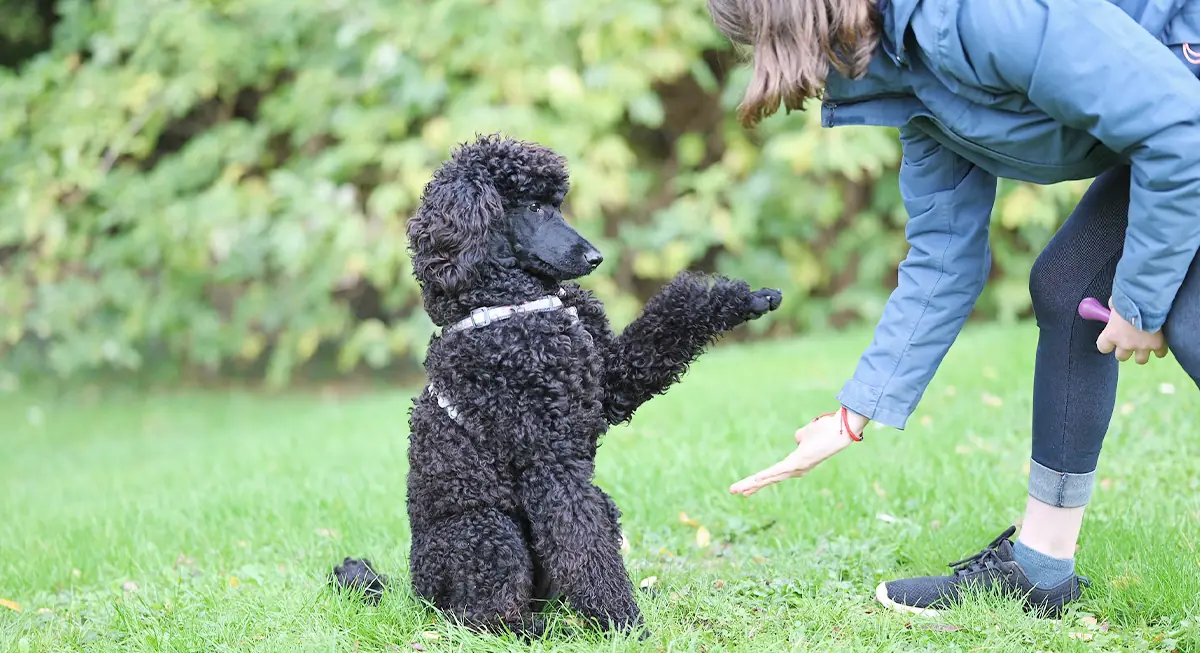
For decades, many people were told that training a dog meant showing who was in charge. If your dog pulled on the leash or ignored a command, the advice was to correct the behavior quickly and firmly. The idea sounded practical: establish dominance, and the dog will respect you.
That approach grew out of dominance theory, often traced to a 1947 wolf study by Rudolph Schenkel. He observed unrelated wolves placed together in captivity. They fought, and he interpreted the behavior as a struggle for alpha status. Later research found those wolves were reacting to stress and confinement, not forming a natural pack hierarchy.
Even after that correction, the “be the alpha” mindset stuck. Trainers used leash jerks, scruff shakes, and sharp verbal reprimands. The logic felt straightforward: assert authority, and the dog falls in line. What it often created, though, was obedience shaped by tension rather than understanding.
As behavioral science advanced, trainers began shifting away from that framework. Modern training draws on learning theory and operant conditioning, which look at how consequences shape behavior. Add something rewarding, and behavior increases. Remove something rewarding, and behavior decreases. These principles are measurable and repeatable, and they also show why punishment carries hidden costs.
What Research Says About Punishment

A 2019 study published on the preprint server BioRxiv compared dogs trained with aversive methods, such as shock collars and leash corrections, to those trained primarily with positive reinforcement. The dogs exposed to aversive techniques exhibited more stress behaviors, such as yawning, lip licking, and pacing. Researchers also measured higher cortisol levels in saliva samples.
Large organizations have adjusted accordingly. Guide Dogs for the Blind has steadily reduced the use of negative training techniques over the past 15 years. According to Susan Armstrong, the group’s vice president of client, training, and veterinary operations, dogs now complete training in roughly half the time it used to take. They also remain in service for 1 to 2 years longer. Lower stress leads to better performance and longer working lives.
Even fields once known for strict correction, including military and detection work, now rely more on rewards. Trainers report quicker skill acquisition and stronger handler relationships.
The Hidden Risks of “Quick Fix” Corrections

Punishment may suppress behavior in the moment, but suppression is not learning. A dog that stops growling after being scolded has not become comfortable. It has learned to hide warning signals. That can escalate risk, especially in situations involving children or unfamiliar surroundings.
Timing presents another problem. If the correction lands a second too late, the dog links it to the wrong action. Confusion builds, fear can creep in, and inconsistent punishment forces owners to correct every single time to avoid accidental reinforcement.
Attention can also reinforce behavior. A dog that jumps for interaction may interpret pushing and loud reprimands as engagement. And so the jumping continues. Positive reinforcement shifts the focus. Instead of teaching what to avoid, it teaches what to do. Reward a sit before greeting, and the dog begins offering that behavior voluntarily. Training becomes clearer, cleaner, and faster.
Socialization and Enrichment
Modern training emphasizes early socialization, especially between eight and 20 weeks of age. Exposure to varied people, surfaces, sounds, and environments builds resilience. Many behavioral problems stem from missed experiences during that critical window.
Enrichment also plays a vital role today. Food puzzles, structured play, and problem-solving tasks reduce boredom. Nina Ottosson popularized interactive puzzle toys years ago, and they are now common tools. A mentally engaged dog spends less time inventing trouble.
Modern dog training does not ignore boundaries, but builds them through clarity, consistency, and reward. Research, field results, and decades of behavioral science point in the same direction. Dogs learn faster when they feel secure, and handlers gain reliability without sacrificing trust.





