
Leopard seals rank among the largest seal species on Earth, with adult females reaching nearly 12 feet in length and weighing more than 1.3K pounds. They possess long canine teeth, powerful jaws that open wide, and a hunting range that includes penguins, fish, krill, and other seals. Scientists classify them as apex predators in Antarctic waters, with orcas being the only known predators that hunt them.
Despite their calm appearance in photographs, leopard seals have been responsible for one recorded human fatality and display rare hunting behaviors. Their ability to move between prey types, dominate multiple levels of the food web, and survive alone in extreme environments places them in a category few ocean predators occupy.
Built for Efficient Violence
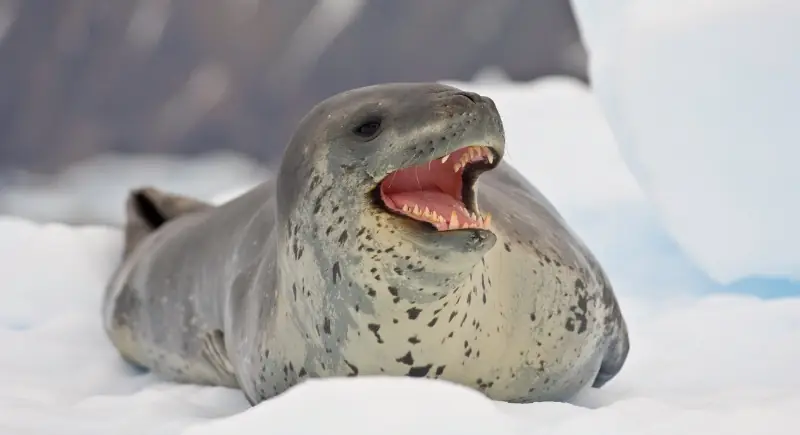
Leopard seals rank among the largest seals on Earth, trailing only elephant seals and walruses in overall size. Their bodies remain long and lean, rather than round, which helps them move quickly through cold water. They can reach speeds of nearly 25 miles per hour, fast enough to ambush prey that relies on quick turns to survive.
The real advantage lies in their mouths. Long front canines lock onto prey, while grooved molars act like a filter. That setup allows a single animal to switch between ripping apart penguins and straining krill from seawater without changing tactics. Few marine predators handle that range so cleanly.
A Predator That Eats Across the Food Web
Leopard seals hunt more broadly than most seals. Penguins make up the most famous part of their diet, but they also eat fish, squid, krill, and other seals. Studies show krill accounts for roughly 45 percent of their intake during parts of the year, which places them in direct competition with whales and other krill feeders. Seasonally, seal pups become targets during breeding months, while penguins peak on the menu during fledging season. At night, leopard seals shift toward krill, and during daylight hours, they move higher up the food chain. That flexibility keeps them fed in an ecosystem that changes quickly.
Impressive Hunting Tactics
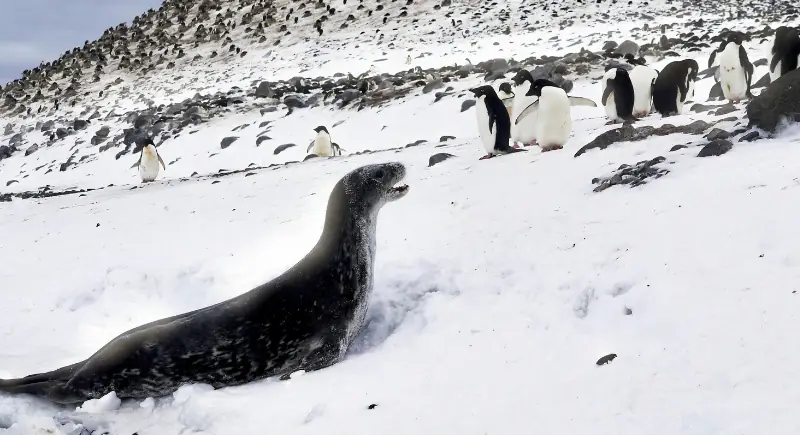
Leopard seals rarely chase prey for long distances. They wait. Penguins enter the water, and the seal attacks in a burst. Once caught, the prey gets flung against the surface until the skin separates, and it looks really brutal. Observers have also recorded behavior that looks like play.
A seal that had already eaten may still chase penguins back and forth near shore. Some scientists think younger seals sharpen their hunting skills this way. Others see it as dominance behavior tied to excess energy. Either way, it reinforces how comfortable these animals are at the top of the system.
Solitary, Vocal, and Hard to Track
Most seals gather in noisy groups, but leopard seals live alone, and adults patrol their own space and tolerate company only during the breeding season. That isolation makes population counts difficult. Estimates suggest at least 35K individuals worldwide, though researchers call that a conservative figure. During mating season, silence breaks.
Leopard seals produce underwater calls that travel long distances. Each seal’s sounds together in patterns that help potential mates locate one another. Older males sound different than younger ones, which adds another layer to selection.
Human Encounters and Real Risk
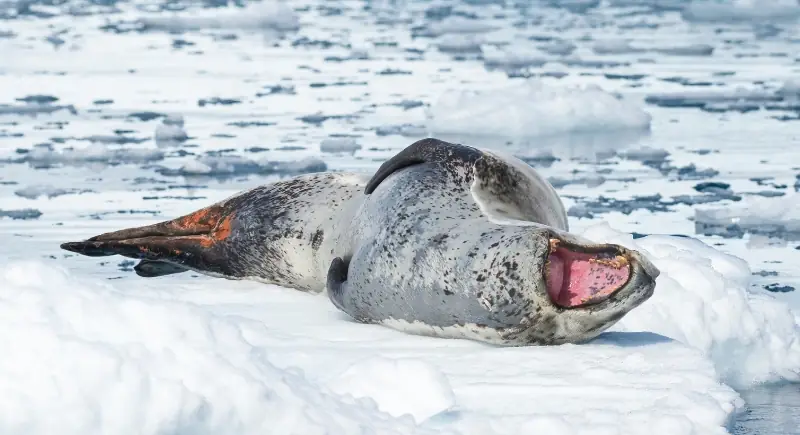
Leopard seals earned a dangerous reputation early in Antarctic exploration logs. Modern data paints a narrower picture. Only one fatal attack on a human appears in records, involving a marine biologist in 2003. Investigations later found little evidence that human behavior triggers attacks. Most close encounters involve curiosity. Seals approach divers, circle, then move on. Conservation groups still advise keeping at least 65 feet of distance and staying alert near ice edges, because the animal’s capacity for harm exists.
Leopard seals sit high in the Antarctic food chain, but they still watch for orcas. Killer whales remain the only confirmed natural predator. Seals that avoid them can live more than 25 years in the wild. That long lifespan, combined with size, speed, and diet range, explains why leopard seals feel so unsettling. They do not hunt constantly, yet they never need to prove dominance. The ocean around Antarctica already does that work for them.





